
The Silent Ranking Factor Destroying Slow Websites
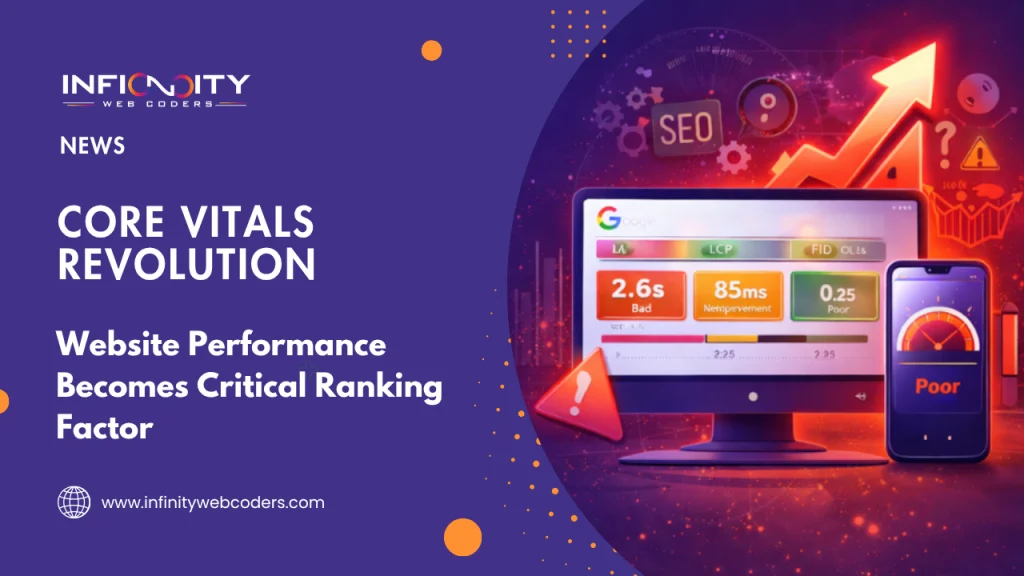
Google has officially strengthened its ranking signals with an updated focus on Core Web Vitals, making website performance and user experience more critical than ever for search visibility.
The latest update emphasizes real-world user experience metrics, signaling a major shift in how websites are evaluated in search rankings. Businesses with slow, unoptimized websites may now face noticeable drops in organic traffic, while high-performing sites stand to gain improved visibility.
What Changed in the 2026 Core Web Vitals Update
The updated ranking system focuses on three key performance metrics:
- Largest Contentful Paint (LCP): Tracks the loading speed of the primary content on a page.
- Interaction to Next Paint (INP): Tracks responsiveness and user interaction delays
- Cumulative Layout Shift (CLS): Evaluates visual stability during page load
Notably, INP has now fully replaced older interaction metrics, making responsiveness a central factor in ranking performance.
Google is also placing greater importance on real user data, meaning websites must perform well for actual visitors, not just in testing tools.
Impact on Website Rankings
Early observations from SEO professionals indicate that the update is already affecting rankings across multiple industries. Websites that fail to meet performance benchmarks are experiencing:
- Drops in search rankings
- Lower organic traffic
- Increased bounce rates
- Reduced engagement
On the other hand, fast-loading and well-optimized websites are gaining competitive advantages in search visibility.
Why Performance Is Now a Priority
This update reinforces a broader trend in digital marketing — user experience is now a ranking factor, not just a design preference.
Search engines are prioritizing websites that:
- Load quickly on mobile devices
- Respond instantly to user interactions
- Maintain stable layouts without sudden shifts
- Provide smooth and seamless browsing experiences
As competition increases, performance optimization is becoming essential for both SEO success and user retention.
Impact on Ecommerce and Business Websites
For ecommerce platforms and service-based websites, the stakes are even higher. Slow-loading pages can lead to:
- Cart abandonment
- Reduced conversion rates
- Loss of customer trust
- Lower search visibility
With more users browsing and shopping on mobile devices, performance optimization is no longer optional — it is a necessity.
What Website Owners Should Do
Experts recommend immediate action to align with the new update:
✔ Optimize images and reduce file sizes
✔ Use faster hosting and content delivery networks (CDNs)
✔ Minimize unnecessary scripts and code
✔ Improve mobile responsiveness
✔ Monitor performance using analytics and real-user data
Regular technical audits can help identify issues early and prevent ranking losses.
The Future of SEO in 2026
The Core Web Vitals update signals a long-term shift toward performance-first SEO strategies. Businesses that invest in speed, usability, and technical optimization will be better positioned to maintain rankings and grow organic traffic.
As search continues evolving, combining high-quality content with strong technical performance will be the key to online success.
Key Takeaway
The 2026 Core Web Vitals update makes one thing clear:
Websites that deliver fast, smooth, and user-friendly experiences will dominate search rankings.Businesses that ignore performance optimization risk falling behind in an increasingly competitive digital landscape.
